A former Cambodian opposition lawmaker was killed on the streets of Bangkok. Which country was behind the shooting?

- Jonathan Head
- BBC Southeast Asia correspondent
The incident had all the hallmarks of a cold-blooded, professional assassination.
A surveillance camera near a well-known temple in Bangkok's historic Royal Palace district captured a man parked his motorcycle and took off his helmet. His face was clearly visible as he calmly crossed the road.
A few minutes later, gunshots were heard and another man fell to the ground.
The killer then quickly returned to the motorcycle, appeared to throw something away, and drove away from the scene.
The victim was named as Lim Kimya, 73, he was a former member of parliament of the Cambodian National Rescue Party (CNRP), which was banned in 2017.
According to Thai police, he had been shot twice in the chest after arriving in Bangkok with his wife on a bus from Cambodia.
An officer attempted to perform CPR but he was pronounced dead at the scene.
"He was a brave and independent-minded man," Monovithya Kem, daughter of Cambodia National Rescue Party leader Kem Sokha, told the BBC.
“No one would want to kill him except the Cambodian government.”
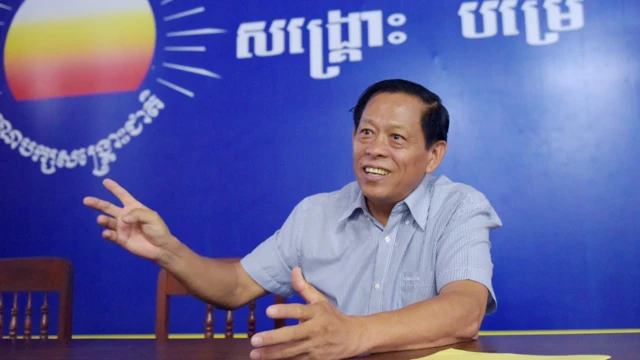
Lim Kimya, who holds dual Cambodian and French citizenship, chose to stay in Cambodia even after his political party was banned.
The Cambodia National Rescue Party (CNRP) was formed by the merger of two earlier opposition parties and almost defeated the party led by self-proclaimed "strongman" Hun Sen in the 2013 election.
Hun Sen ruled Cambodia for nearly 40 years until he handed over power to his son Hun Manet in 2023.
After a narrow defeat in the 2013 elections, Hun Sen accused the CNRP of treason and outlawed it, subjecting its members to legal and other forms of harassment. In 2023, CNRP leader Kem Sokha was sentenced to 27 years in prison, having already spent six years under house arrest.
High-level political assassinations, while not unheard of, are relatively rare in Cambodia: Kem Ley, a prominent political analyst and critic of Hun Sen, was shot dead in Phnom Penh in 2016, and environmental activist Chut Wutty was killed in 2012.
Based on the footage captured by surveillance cameras, Thai police have confirmed that the murderer of Lin Jinya is a former Thai naval officer who is currently a motorcycle taxi driver. It should not be difficult to find him.
But whether the murder will be fully investigated is another matter.
Dozens of activists who have sought to flee repression in Cambodia, Vietnam, Laos and Thailand have been deported in recent years after seeking asylum, or have been killed or disappeared.
Human rights groups believe there is an unwritten agreement among the four neighboring countries to allow each other's security services to cross borders and hunt down dissidents.
Last November, Thailand deported six Cambodian dissidents and a young child to Cambodia, where they were imprisoned. All were recognized as refugees by the United Nations. Earlier that year, Thailand also deported a Vietnamese Montagnard activist to Vietnam.
In the past, Thai anti-monarchy activists have been kidnapped or disappeared in Laos, which is widely believed to be an operation by Thai security forces abroad. In 2020, a young Thai activist in exile in Cambodia, Wanchalearm Satsaksit, was kidnapped and disappeared, which was also believed to be the work of Thai agents.
However, Cambodian authorities conducted only a minor investigation and announced last year that the case was closed. A similar situation may also happen in Lin Jinya's case.
“Thailand is effectively hosting a ‘quid pro quo’ arrangement,” said Phil Robertson, Thailand director for Asia Human Rights and Labour Advocates. “Dissidents and refugees are being traded for political and economic gain between neighbouring countries. The growing transnational repression in the Mekong sub-region must be stopped.”
When Hun Manet, educated in the United States and Britain, succeeded his father, Hun Sen, as Cambodia's prime minister, there was speculation that he might adopt a softer approach to governing. However, opposition figures continue to be prosecuted and jailed, and the remaining space for political dissent has been almost completely closed.
Hun Sen, who is semi-retired but still wields influence behind his son's government, is calling for a new law to label anyone who tries to replace him as a terrorist.
Thailand, which lobbied hard this year for election to the United Nations Human Rights Council, will now face pressure to prove it can bring to justice the perpetrators of assassinations carried out on the streets of its capital.


Comments
Post a Comment