More details on Yoon Seok-yeol's arrest: 1,000 police officers deployed, using wire cutters and ladders to overcome obstacles, Yoon wanted to surrender but was refused

South Korean President Yoon Seok-yeol was arrested by the South Korean Senior Public Officials Crime Investigation Office (CIO).
Yoon Seok-yeol briefly declared martial law on December 3 last year and became the country's first sitting president to be arrested 43 days later. He has been impeached by Congress and is currently suspended from office.
Public prosecutors said Yoon Seok-yeol refused to testify. His party members also said in an interview that he plans to maintain his right to remain silent. Currently, the detention and interrogation period is only 48 hours. Yoon Seok-yeol will stay overnight in the Seoul Detention Center. Investigators can apply for a formal arrest warrant of up to 20 days within these 48 hours.
In Yoon Seok-yeol's recorded video, he said that he was willing to accept the investigation in order to prevent any unpleasant bloodshed, but that did not mean he acknowledged the validity and legality of the investigation. He also said that the rule of law in South Korea had "completely collapsed."
Second arrest
Previously, Yoon Seok-yeol had refused the summons for investigation by the Public Prosecutions Office three times.
The Public Prosecutor's Office tried to arrest Yoon Seok-yeol on January 3 but failed. After investigators confronted soldiers and presidential guards in the official residence for a whole morning, the Public Prosecutor's Office announced at noon that it would suspend the execution of the arrest warrant.
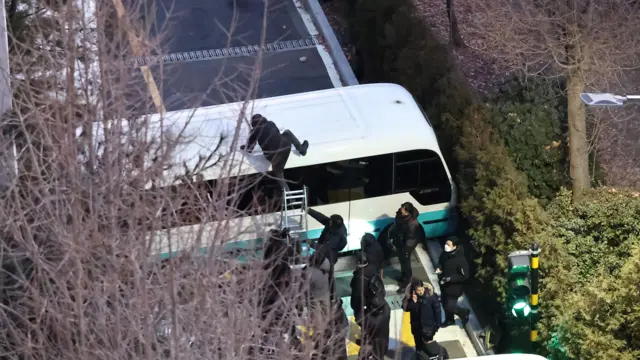
Afterwards, Yoon Seok-yeol's security personnel stepped up their vigilance and used barbed wire and buses as roadblocks.
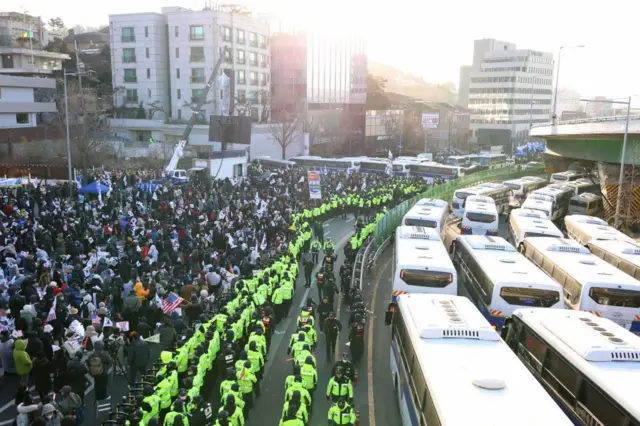
This morning at around 5:45 a.m. local time, personnel from the Public Prosecutor's Office and about 1,000 police officers arrived at the presidential residence and once again attempted to execute an arrest warrant against suspended President Yoon Seok-yeol.
They crossed the barricade with wire cutters and ladders.
Local media reported that dozens of lawmakers from the ruling National Power Party formed a human wall outside the official residence.
Yoon Seok-yeol's legal team argued that the detention was intended for public humiliation and said at one point that they were discussing with the authorities the possibility of Yoon Seok-yeol turning himself in to the Public Prosecutor's Office. The Public Prosecutor's Office said that it would not consider Yoon Seok-yeol turning himself in and insisted on executing the arrest warrant.
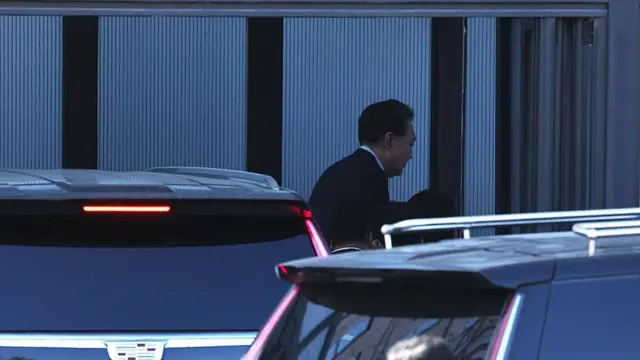
The arrest warrant was executed at 10:33 a.m. local time (01:33 GMT), the Public Prosecutions Office confirmed.
It was reported that after leaving the presidential residence, Yoon Seok-yeol's motorcade arrived at the Public Prosecutor's Office.
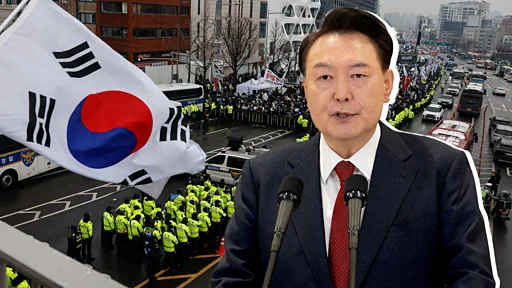
Some National Power Party lawmakers condemned the arrest as "illegal", and some supporters of Yoon Seok-yeol demonstrated in front of the Public Mediation Office building to protest the detention.
According to BBC reporters' observations on the scene in South Korea, after the news of Yoon Seok-yeol's arrest came out, the opposition camp sang and celebrated. On the other hand, some supporters lay on the ground crying, while others said, "We are very frustrated and angry - the rule of law has collapsed."
The two sides have clear positions, reflecting the polarization in South Korea.
What's next?
South Korea has long had serious divisions between conservatives and progressives, and politics fell further into chaos after martial law.
On December 3 last year, Yoon Seok-yeol briefly declared martial law.
On December 14, the National Assembly, with the opposition party in the majority, passed a motion to impeach Yoon Seok-yeol, and Yoon was suspended from office.
On December 30, a South Korean court issued an arrest warrant for Yoon Seok-yeol on suspicion of inciting civil unrest and abuse of power. This is the first time in South Korea's constitutional history that an arrest warrant has been issued against a sitting president.
The presidential privilege of immunity from criminal prosecution does not apply to charges of rebellion or treason.
Yoon Seok-yeol has argued that martial law was an "act of governance."
Currently, the detention period for Yoon Seok-yeol is only 48 hours. The Public Prosecutor's Office will then need to apply to the court for a formal arrest warrant. If approved, the period can be as long as 20 days. Otherwise, Yoon Seok-yeol must be released.

Yesterday (January 14), the Constitutional Court of South Korea initiated trial proceedings on the impeachment case of Yoon Seok-yeol to decide whether to remove the suspended Yoon Seok-yeol, but the person concerned was absent due to security reasons.
The trial ended in just four minutes and is scheduled to be held again this Thursday. If the party still fails to appear in court for the second time, the court can proceed with the trial in his absence.
The Constitutional Court must complete the impeachment trial procedures within 180 days. If it rules that the impeachment is not valid, Yoon Seok-yeol will immediately resume his presidential duties.
Even though Yoon Seok-yeol has been arrested, South Korea's political crisis is not over.


Comments
Post a Comment