Trump signs executive order imposing tariffs on China, Mexico and Canada
- Jessica Murphy, Will Grant
- BBC reporters in Toronto and Mexico City
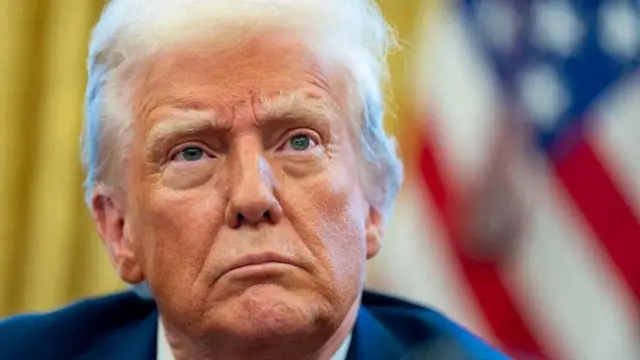
U.S. President Donald Trump announced new tariffs on all imports from the United States' three major trading partners, China, Mexico and Canada.
Trump said the United States would impose 25% tariffs on Canada and Mexico and 10% tariffs on China. Canadian energy faces a lower tariff of 10%.
He threatened to impose import taxes if the three countries did not address his concerns about illegal immigration and drug smuggling.
Both Canada and Mexico have said they are preparing retaliatory tariffs.
Trump said he was prepared to escalate tariffs if the countries retaliated.
Last year, these three countries accounted for more than 40% of U.S. imports.
"Today's tariff announcement is necessary to hold China, Mexico, and Canada to their commitments to stem the flood of toxic pharmaceuticals into the United States," the White House said in a statement on Saturday.
"This is being done through the International Emergency Economic Powers Act (IEEPA) because illegal immigration and deadly drugs, including Fentanyl, pose a significant threat of killing our citizens," Trump said in a post on his Truth Social platform.
In reality, tariffs are domestic taxes levied on goods entering the country, proportional to the value of the imports.
Trump sees it as a way to grow the U.S. economy, protect jobs and raise tax revenue — and in this case, a way to nudge allies into policy action.
In response, Mexican President Claudia Sheinbaum called allegations that her government was aligned with criminal organizations "slanderous."
In a statement, the White House accused the Mexican government of forming an "intolerable alliance" with Mexican drug cartels.
President Sheinbaum said Mexico is willing to work with the U.S. "Problems are not solved by imposing tariffs, they are solved through dialogue."
She has instructed her economy minister to respond with tariff and non-tariff measures, which are expected to include retaliatory tariffs of 25% on U.S. goods.
Canadian Prime Minister Justin Trudeau said Canada would also respond.
His government will impose 25% tariffs on C$155 billion worth of U.S. goods, with C$30 billion of that taking effect on Tuesday and another C$125 billion in 21 days.
Targeted goods include American beer, wine, bourbon, fruit and juice, vegetables, perfume, clothing and shoes, as well as household appliances, sporting goods and furniture. Wood and plastics will also face tariffs.
Although Trudeau did not provide further details, the non-tariff measures under consideration are related to critical minerals and sourcing.
With Trump's return to the presidency, a trade war has revived between the world's two largest economies, with China warning the United States against protectionism.
China said in a statement that it was strongly dissatisfied with and "firmly opposed" the levies.
China's Foreign Ministry added that it would file a complaint with the World Trade Organization over the "wrong practices" of the United States and would take countermeasures to "safeguard its own rights and interests."
Chinese Vice Premier Ding Xuexiang told the World Economic Forum in Davos, Switzerland last month that China was seeking a "win-win" solution to trade tensions and wanted to expand imports.
Canada and Mexico said they would respond to U.S. tariffs on their goods with measures of their own, while also seeking to reassure Washington that they were taking action to address concerns about their U.S. border.
In a bid to avoid tariffs altogether, Ottawa has pledged to implement new security measures worth C$1.3bn (US$900m; £700m) at its US border.
The Canadian Chamber of Commerce issued a statement before Trump's "deeply troubling tariff decision," saying the tariffs will have "immediate and direct impacts on livelihoods in Canada and the United States" and will "substantially increase all costs for everyone."
The economies of Canada, Mexico and the United States are deeply integrated, with an estimated $2 billion worth of manufactured goods crossing their borders every day.
Economists say tariffs and subsequent retaliation could raise prices on a wide range of products, from cars, lumber and steel to foods such as frozen French fries, avocados and tomatoes to alcohol.
The auto industry could be particularly hard hit. Auto parts cross three borders multiple times before being assembled into a final vehicle. TD Economics said the average U.S. car price could rise by about $3,000.
A January report from the Peterson Institute for International Economics showed that imposing a 25% tariff on Canada and Mexico would slow economic growth and accelerate inflation in those three countries.
U.S. industry groups have also sounded the alarm.
The National Association of Home Builders said the tax would likely increase housing costs.
The Free Trade Farmers Association said that with many American farmers already struggling, "increasing tariffs will only worsen the situation in large parts of rural America."
The Retail Industry Leaders Association, which has more than 200 members including big names like Home Depot, Target and Walgreens, said it hoped the tariffs could still be avoided.
The White House said Saturday that Mexican drug cartels are responsible for trafficking fentanyl, methamphetamine and other drugs in explaining why it was targeting its main trading partner.
The White House said tariffs on Canada will remain in place until it "partners with the United States on combating drug traffickers and border security."
Finally, the White House said that "China plays a central role in the fentanyl crisis" by exporting the deadly synthetic painkiller.
Official data shows that drug seizures are reported at both the northern and southern U.S. borders, but seizures at the border with Canada are far lower than those at the border with Mexico.
Between October 2023 and September last year, U.S. border agents seized 43 pounds (19.5 kilograms) of fentanyl on the northern border, while more than 21,000 pounds (9,525.4 kilograms) were seized on the southern border.
Sophie Avernin, director of a Mexican company, said Trump's actions could cause damage far beyond the borders of the countries directly involved.
She noted that what is known as Mexico's "Modelo" beer brand is actually owned by a Belgian company.
“He doesn’t understand that this is going to have global implications,” she said. “This is going to have impacts everywhere.”
She worries about what's coming next: "Americans are going to pay more for the things they buy. They're going to spend less. ... The economy is going to slow down."
“Trump’s reasons for imposing tariffs are different from before”
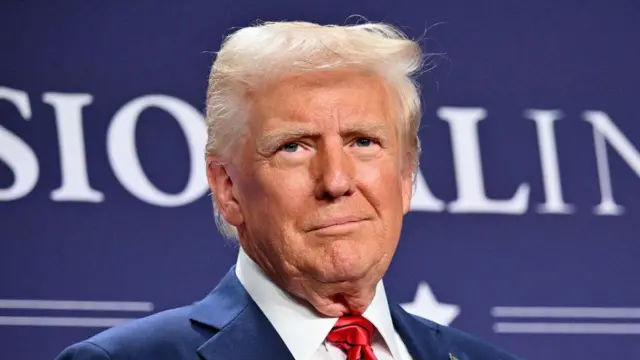
It may seem hasty, but it's worth understanding what legal basis President Trump is citing for his tariff announcement, says BBC business correspondent Natalie Sherman, reporting from New York.
During his first term, Trump waged a trade war that cited rules allowing the use of tariffs in response to unfair trade practices or national security concerns.
This time he declared a national emergency due to "illegal immigration and drugs" and used this power to impose tariffs.
This is not an obscure law — it is often used to impose sanctions on countries like Russia or Venezuela.
But it is unusual for tariffs. Unlike routes he has used in the past, it allows the president to skip steps such as investigations and comment periods.
Everett Eissenstat, a trade lawyer who served as White House economic adviser during Trump's first term, told the BBC earlier this month that the idea was first discussed: "It's a very powerful statute that I think has the potential to impose these kinds of pervasive tariffs in a way that has never been done before."
How have the parties responded?
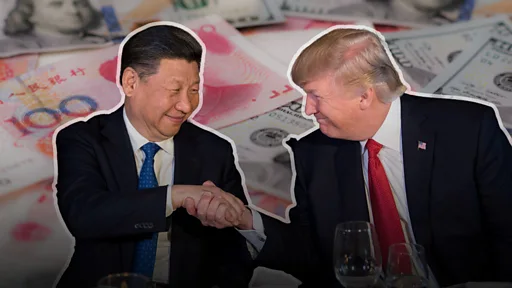
China vows to take 'corresponding countermeasures' against US
China's Foreign Ministry expressed "strong dissatisfaction and resolute opposition" to U.S. President Trump's order to impose a 10% tariff on Chinese products exported to the United States, while China's Ministry of Commerce called the move a "serious violation" of World Trade Organization rules.
China's Ministry of Commerce said in a statement that it would file a complaint with the WTO over the "wrong practices" of the United States and would take countermeasures to "safeguard its own rights and interests."
A Chinese Foreign Ministry spokesman said the U.S. move to impose additional tariffs "seriously violates WTO rules, will not only fail to solve its own problems, but will also be detrimental to both sides and the world."
A Chinese Foreign Ministry spokesperson said: "The practice of imposing additional tariffs is not constructive and will inevitably affect and damage future cooperation between the two sides on drug control. China urges the United States to correct its wrong practices, maintain the hard-won good situation of China-US drug control cooperation, and promote the stable, healthy and sustainable development of China-US relations."
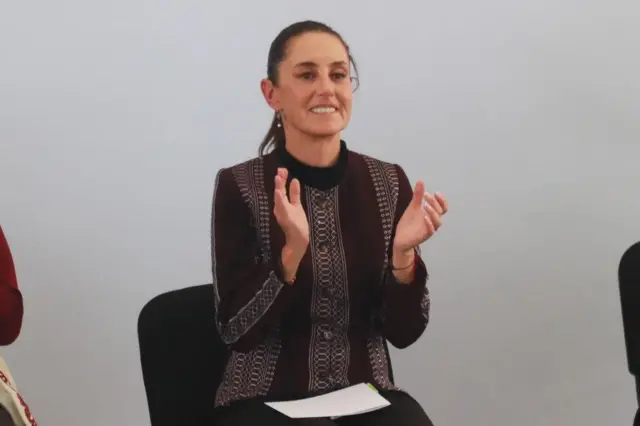
Mexican president responds strongly to Trump
The BBC's Will Grant, reporting from Mexico City, says Mexican President Claudia Sheinbaum has struck a strong tone in her response to the US tariffs.
Posting on the social media handle "X", President Sheinbaum described the White House statement as a "slander" against the Mexican government, which the Trump administration has accused of forming an "intolerable alliance" with Mexican drug cartels.
"If there is such an alliance," Sheinbaum wrote, "it is that American gun manufacturers sell high-powered weapons to these criminal groups." It is part of a years-long dispute between Mexico and Washington, and she called on the United States to do more to combat the illegal flow of guns to South Africa to arm drug cartels.
President Sheinbaum said Mexico did not want a confrontation and she proposed setting up a joint task force between their respective public health and security teams.
Her key point, however, came at the end of her statement: She had instructed Economy Minister Marcelo Ebrard to implement what she called "Plan B," adding that it included "tariff and non-tariff measures to defend Mexico's interests."
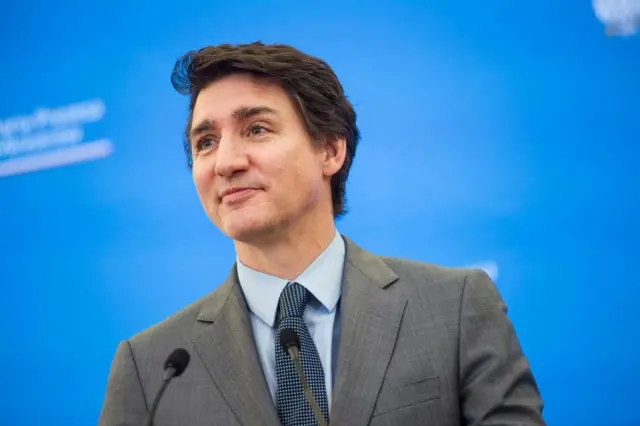
Trudeau says Canada 'will not back down'
Canadian Prime Minister Justin Trudeau said Canada will impose its own tariffs in retaliation for Trump's tariffs on Canadian imports.
Trudeau said his government would impose tariffs of 25% on C$155 billion worth of U.S. goods.
Trudeau said the first round of tariffs will take effect on Tuesday, targeting $30 billion worth of U.S. goods, followed by further duties on $125 billion worth of products within 21 days.
Trudeau told a news conference he wanted to speak directly to Americans, saying it would have a direct impact on prices and the U.S. economy.
Trudeau said the next few weeks will be difficult for Canadians and Americans.
He said this trade action by the Americans and our response will have real impacts on people and workers on both sides of our border.
“We don’t want to be here, we didn’t ask to do this,” he said. “But we will not back down from defending the Canadian people” and the successful partnership between Canada and the United States.
Concerns and opportunities for Southeast Asian economies
BBC Asia business correspondent Suranjana Tewari reports that Southeast Asian businesses are watching the tariff news closely. Their supply chains extend as far as Mexico and Canada, as they are close to the US, the final destination for some of their exports.
But the region relies on China's power, which remains the number one source of materials, equipment and parts. Malaysia, Singapore and Thailand are major players in the region's electronics supply chain. The Philippines and Vietnam also play important roles in the production process.
It would be costly and difficult to completely exclude China from the production process. But with Trump moving forward with his 10% tariffs on Beijing and retaliatory tariffs expected on U.S. products, supply chains could be upended, leading to shortages.
We have been here before, with Trump’s punitive tariffs on Chinese goods in 2018 and 2019 causing some production to move from China to Southeast Asia. With new tariffs on China, Mexico, and Canada, the manufacturing ecosystem is likely to restructure further.
Who is allying with whom?
BBC business correspondent Jonathan Josephs reports that the United States has been working with its allies in some ways over the past few years on trade with China.
Canada and the European Union joined Washington in imposing tariffs on Chinese electric vehicles in 2024.
They argue that Beijing is unfairly undercutting its own car prices, something China denies.
Steel is another area of cooperation that often comes up in trade wars because it is important to the defense industry, which uses it to build warships, among other things.
China produces nearly 60% of the world's steel, but Western countries have been working to reduce that share.
They have discussed plans to impose tariffs on steel that doesn’t meet environmental standards, which would hurt China the most, but so far nothing has come of it.


Comments
Post a Comment